Allies to Trump: We’ll Live With Tariffs, Just Don’t Make Them Any Higher
Countries are pushing the president to stick to deals made last year though some bristle at U.S. allegations of unfair trade practices
By Kim Mackrael, Jason Douglas and Hannah Miao
March 14, 2026 8:00 am ET
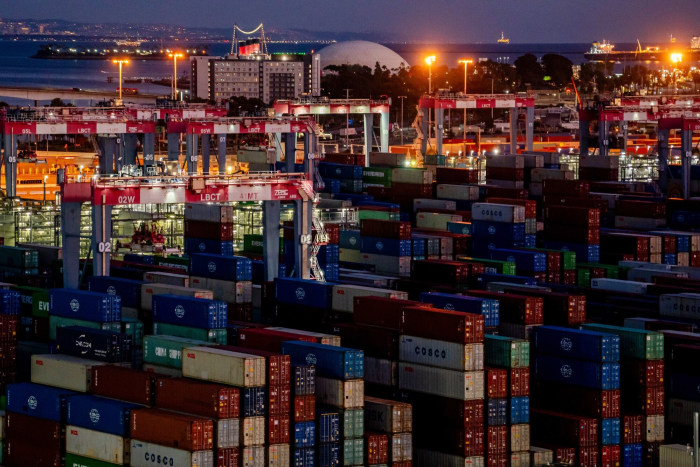
Shipping containers at the Port of Long Beach, Calif. Kyle Grillot/Bloomberg News
Quick Summary
U.S. trading partners are pushing President Trump to stick to previously agreed tariff levels after his administration kicked off probes aimed at replacing the levies struck down by the Supreme Court.
While most countries targeted by Trump are resigned to tariffs, they are also challenging the economic arguments the U.S. used to justify the latest move, previewing a likely legal battle.
In February, the U.S. high court said Trump couldn’t impose tariffs using his powers under a 1970s law involving international emergencies. Trump quickly imposed a global 10% tariff using different authority, but that expires after 150 days.
This past week, U.S. Trade Representative Jamieson Greer said the U.S. was starting investigations under Section 301 of the Trade Act of 1974, citing what he called unfair practices such as running trade surpluses and building up too much industrial capacity. The move is likely to lead to tariffs on most of America’s major trading partners including the European Union, Mexico, China, Japan, South Korea, India and others.
“I understand that the main focus for the U.S. is returning tariffs to the levels seen before the Supreme Court” made its ruling, said Yeo Han-koo, South Korea’s trade minister.
The U.S. and EU struck a deal last year that capped American tariffs on most EU goods at 15%. A spokesman for the European Commission, the bloc’s executive body, said the EU expected the U.S. to honor the bargain.
“We have not received any indication that the U.S. administration intends to deviate from those commitments,” said the spokesman, Olof Gill.
South Korea, Japan and Taiwan also struck deals with Trump last year to pay 15% tariffs on many goods and are calling on him to keep those deals. South Korea’s legislature this week approved legislation clearing the way for $350 billion in investments in the U.S., part of the bargain Seoul made with Washington.
Greer has said the U.S. is looking for continuity and intends to stick by its earlier trade deals.
Section 301 is a tried and tested tool for imposing tariffs and wringing concessions from U.S. trade partners. Once levies are in place, Trump can raise or lower them as a negotiating tool, as he did with Section 301 tariffs on China imposed during his first term.
Yet putting legally defensible tariffs in place isn’t simple.
Section 301 requires a formal investigation that often takes a year or more, while the Trump administration hopes to finish these probes by July. The U.S. must show that the foreign practices harm American commerce and that the 301 tariffs match the harm done.
Foreign officials bristled at the discussion of excess capacity in the Trump administration’s notice opening the Section 301 probes.
“The EU is a market driven economy,” said Gill, the European Commission spokesman. “The EU does not consider itself a contributor to structural excess capacity, but rather a partner in addressing global distortions.”
The USTR’s notice said Singapore had a trade surplus with the U.S. for goods and services of $27 billion in 2024. In a rebuttal, Singapore’s government cited official U.S. figures showing it was the U.S. that enjoyed the $27 billion surplus in two-way trade, not the other way around.
Anticipating more tariffs “is different from waking up to discover that you have been accused of unfair trade practices. That’s the sort of shock the region is experiencing,” said Deborah Elms, head of trade policy at the Hinrich Foundation in Singapore, which supports open trade.
Beijing was the most strident in its opposition to the Section 301 probes. Its Commerce Ministry said Friday that the U.S. had no right to unilaterally determine whether a trading partner had overcapacity.
Chinese manufacturers have increasingly turned to exports to boost economic growth, and China’s trade surplus hit $1.2 trillion last year.
“China is the primary source of the problem,” said Tim Brightbill, an international trade attorney and co-chairman of the trade practice group at Wiley Rein.
Still, Beijing is unlikely to retaliate right away, at least until the investigation concludes and any new tariffs are formally announced, said Wendy Cutler, a former U.S. trade negotiator now at the Asia Society Policy Institute in Washington, D.C.
The issue is likely to come up when Treasury Secretary Scott Bessent meets Chinese Vice Premier He Lifeng in France on Sunday.
Copyright ©2026 Dow Jones & Company, Inc. All Rights Reserved. 87990cbe856818d5eddac44c7b1cdeb8
Appeared in the March 16, 2026, print edition as ‘Nations Press Trump to Honor Negotiated Tariff Levels’.
Kim Mackrael is a reporter for The Wall Street Journal in Brussels.
Jason Douglas is the Tokyo bureau chief of The Wall Street Journal, overseeing the Journal’s coverage of economics, finance, business and politics in Japan. He was previously the paper’s Asia economics reporter in Singapore, where he wrote about China’s economy and global trade. He joined Dow Jones & Co. in 2007 as a newswires reporter in London after stints in the U.K. business press and newspapers in Northern Ireland. Follow
Hannah Miao is a reporter for The Wall Street Journal based in Singapore, covering China’s economy and its ties with Asia and the world. Previously, she reported on financial markets, investing and brokerages for the Journal in New York. Hannah started her career at CNBC.
View this Wall Street Journal article CLICK HERE
 Media Air Base, LLC
Leave a comment