Arm Holdings to Sell Its Own Chips. Some Customers Could Become Rivals.
By Adam Levine
Updated March 24, 2026, 5:34 pm EDT / Original March 24, 2026, 3:19 pm EDT
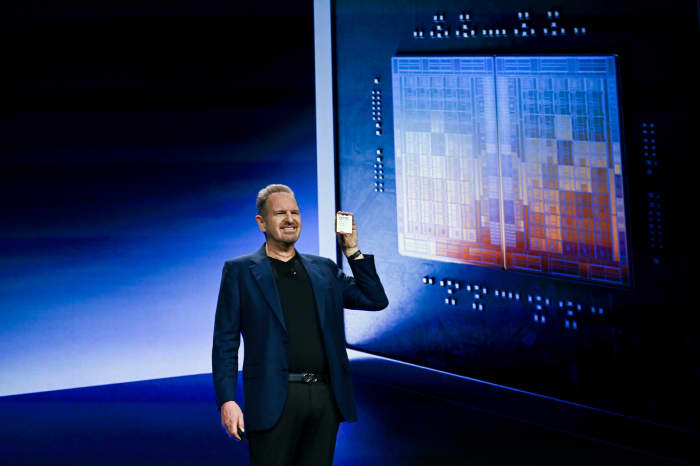
Arm Holdings CEO Rene Haas. In a pivot, Arm will sell its own chips. (David Paul Morris/Bloomberg)
Key Points
About This Summary
- Arm announced a new data center CPU chip, the Arm AGI CPU, directly competing with its customers.
- Meta Platforms and OpenAI are initial customers for the Arm AGI CPU, with Meta citing significant improvements in data center performance.
- The new chips will compete with data center CPUs from Intel and Advanced Micro Devices.
Arm Holdings has crossed the Rubicon. In announcing a new data center CPU chip on Tuesday, it is putting itself into direct competition with its customers, notably Nvidia, Amazon, Alphabet, and Microsoft.
At its core, Arm makes intellectual property that chip makers license to build their own chips. Arm customers also include Apple, Qualcomm, Samsung, and Broadcom. Just about every smartphone, tablet and even Mac computers run on top of Arm designs.
But Arm has never before made a chip.
“AI has fundamentally redefined how computing is built and deployed,” said Arm CEO Rene Haas in a press release. “Today marks the next phase of the Arm compute platform and a defining moment for our company.”
Arm shares were down 1.4% on Tuesday, but just after the close of trading, Haas revealed that the company expects to see $15 billion in sales from the chips in five years, and $25 billion revenue in all. Arm is expected to have sales of $4.9 billion in fiscal year 2026, which ends this month. The stock shot up 6% on the news in after-hours trading.
Meta Platforms, OpenAI and smaller players will be the first customers for the chip, called Arm AGI CPU.
“Delivering AI experiences at global scale demands a robust and adaptable portfolio of custom silicon solutions, purpose-built to accelerate AI workloads and optimize performance across Meta’s platforms,” said Meta head of infrastructure Santosh Janardhan in a statement. “We worked alongside Arm to develop the Arm AGI CPU to deploy an efficient compute platform that significantly improves our data center performance density and supports a multi-generation roadmap for our evolving AI systems.”
These new chips will compete with data center CPUs from Intel and Advanced Micro Devices
AMD+1.33%, which are based around different intellectual property called x86, and also other Arm-based chips at the big cloud companies.
Previously used only in low-power devices, Amazon
AMZN-1.38% Web Services introduced Arm into the data center with its first Graviton CPU chip in 2018. Microsoft has its Cobalt Arm chip in the Azure cloud, and Google Cloud has the custom Axion CPU. Nvidia’s Grace and Vera Arm-based CPUs populate its industry-leading artificial-intelligence servers.
This represents the most dramatic change in business model since Arm was founded in 1990 as an Apple
AAPL+0.06% joint venture with two smaller companies. The shift may anger customers, but there may be little alternative. x86 licenses from Intel and AMD are not forthcoming and the open-source RISC-V chip architecture may not be mature enough.
When queried about competing with customers at a press conference, Haas said, “It is a massive, massive market. We think there’s room for lots of different players, so we’re not really too worried about that.”
The competition also opens up the question of who the customers for Arm AGI CPU will be when the largest buyers—AWS, Azure and Google Cloud—have their own CPUs.
As much as the cloud has taken over computing, there’s still a lot happening on corporate servers, which are either IBM mainframes or x86 servers running Intel or AMD hardware. Key back end software from companies like SAP and Oracle run on these systems, and replacing these x86 servers could be a place where Arm AGI CPU could find success.
If it does, that could even work to the advantage of the cloud providers. One of Arm’s strengths is the army of mobile and PC software developers that has grown up since iPhone debuted in 2007 with an Arm chip. But Arm is less prevalent in enterprise software and a wave of corporations migrating their on-premises x86 servers to Arm AGI could remedy that. In doing so, it would benefit the entire Arm ecosystem, including the cloud providers.
Since Hass became CEO in 2022, Arm has been aggressively pursuing revenue growth through price hikes and bundling, and the latest gambit is another move to keep that momentum going. In the most recent quarter, Arm reported revenue growth of 26% from the previous year.
Write to Adam Levine at adam.levine@barrons.com
View this Barron’s article CLICK HERE
 Media Air Base, LLC
Leave a comment